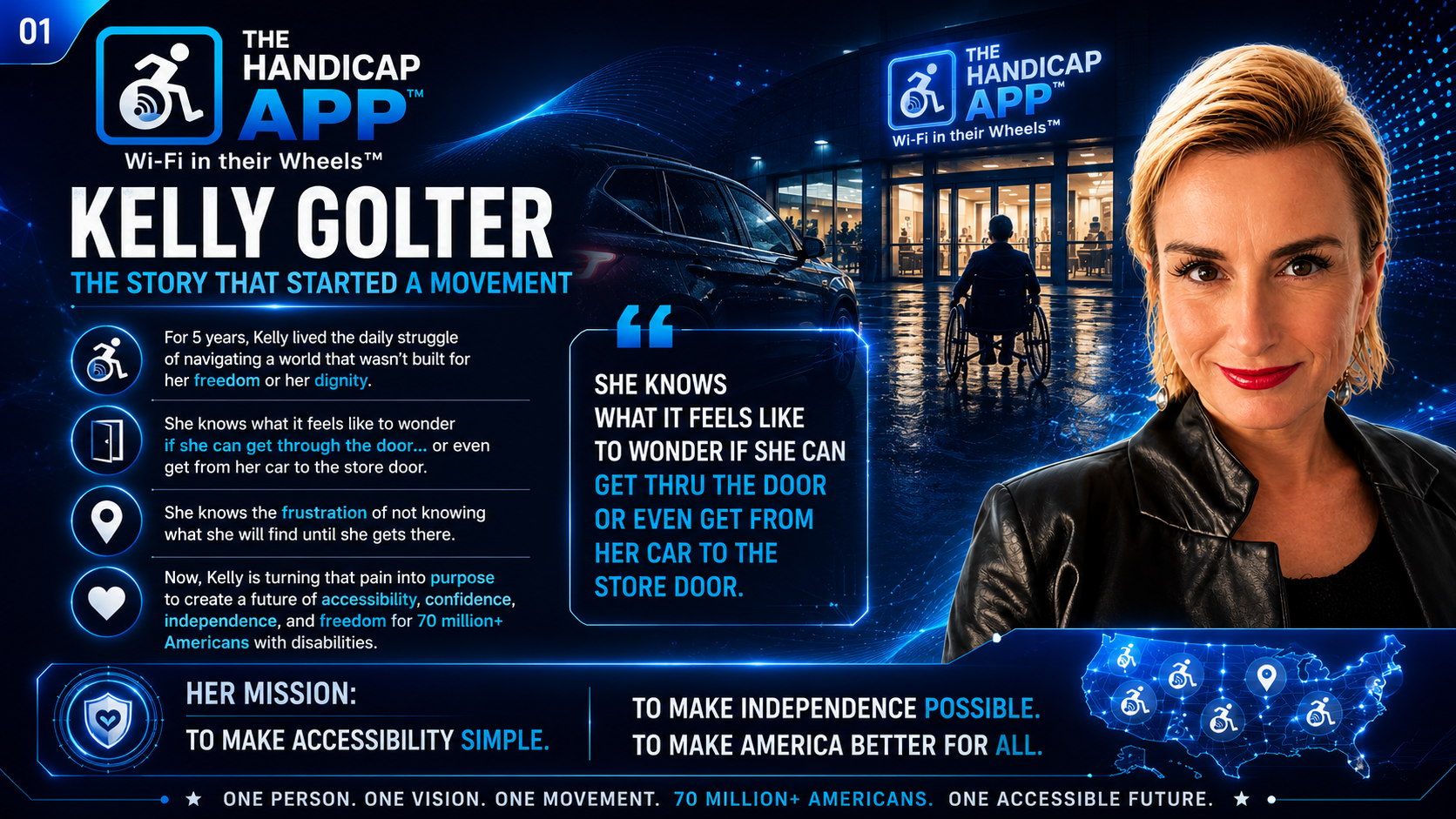
“Every great solution begins with understanding the problem. For The Handicap App, that understanding comes from our founder, Kelly Golter. Kelly spent five long years struggling with severe mobility limitations and experienced firsthand the uncertainty millions of Americans face every day. Can I get from my car to the entrance? Is there an accessible way inside? Can I get through the door? Will there be a restroom I can actually use? Kelly didn't learn these problems from statistics. She lived them. And from that experience came a commitment: there has to be a better way. That commitment became The Handicap App.”
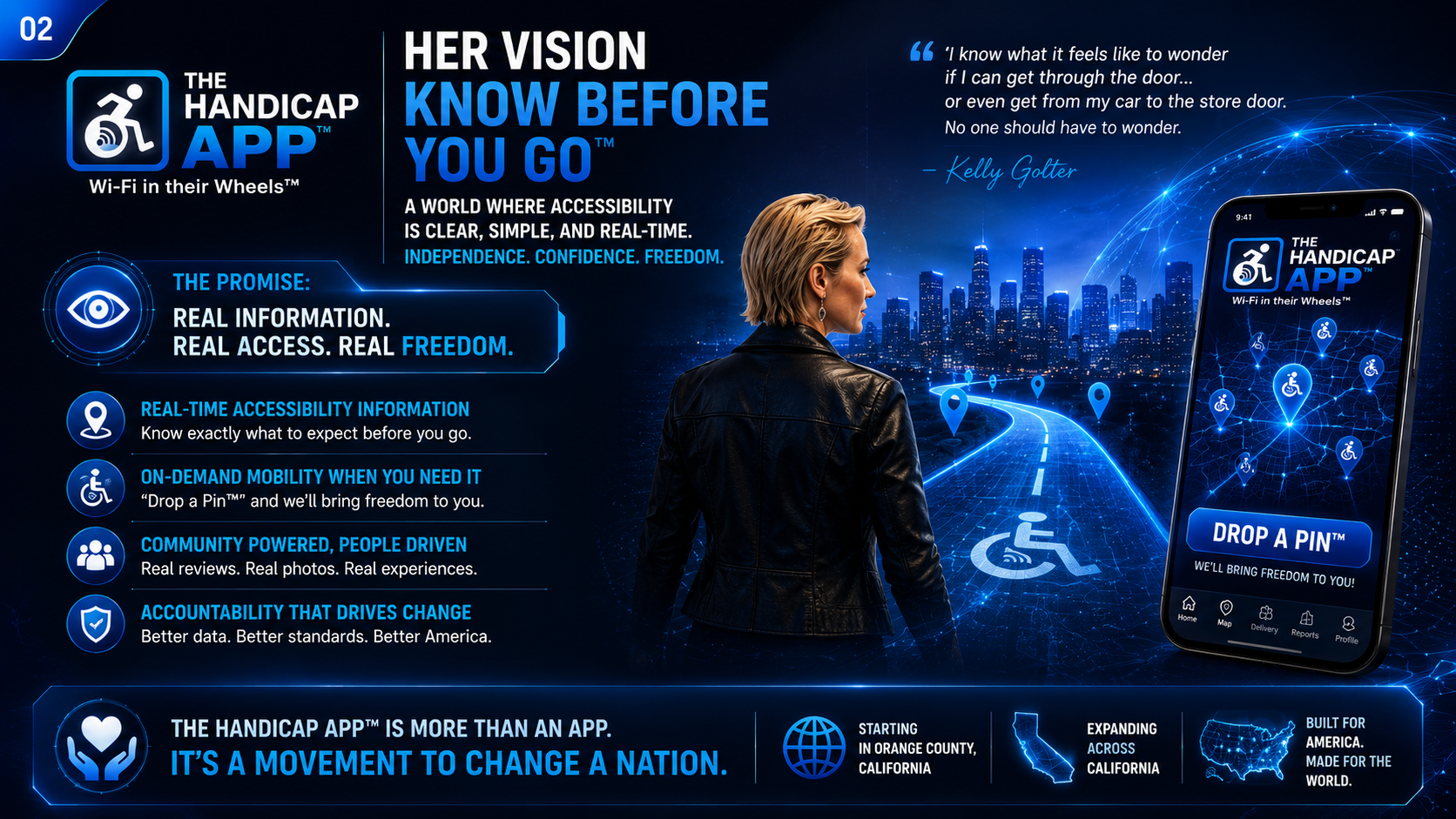
“Kelly's vision begins with a very simple promise: Know Before You Go. People with disabilities shouldn't have to arrive somewhere before discovering whether they can navigate it. Imagine opening one application and knowing what accessibility conditions you will encounter before leaving home. Where can I park? Is there an accessible entrance? Can I navigate the building? Is there an accessible restroom? What have other people with disabilities experienced? We want to replace uncertainty with information—and information with confidence.”
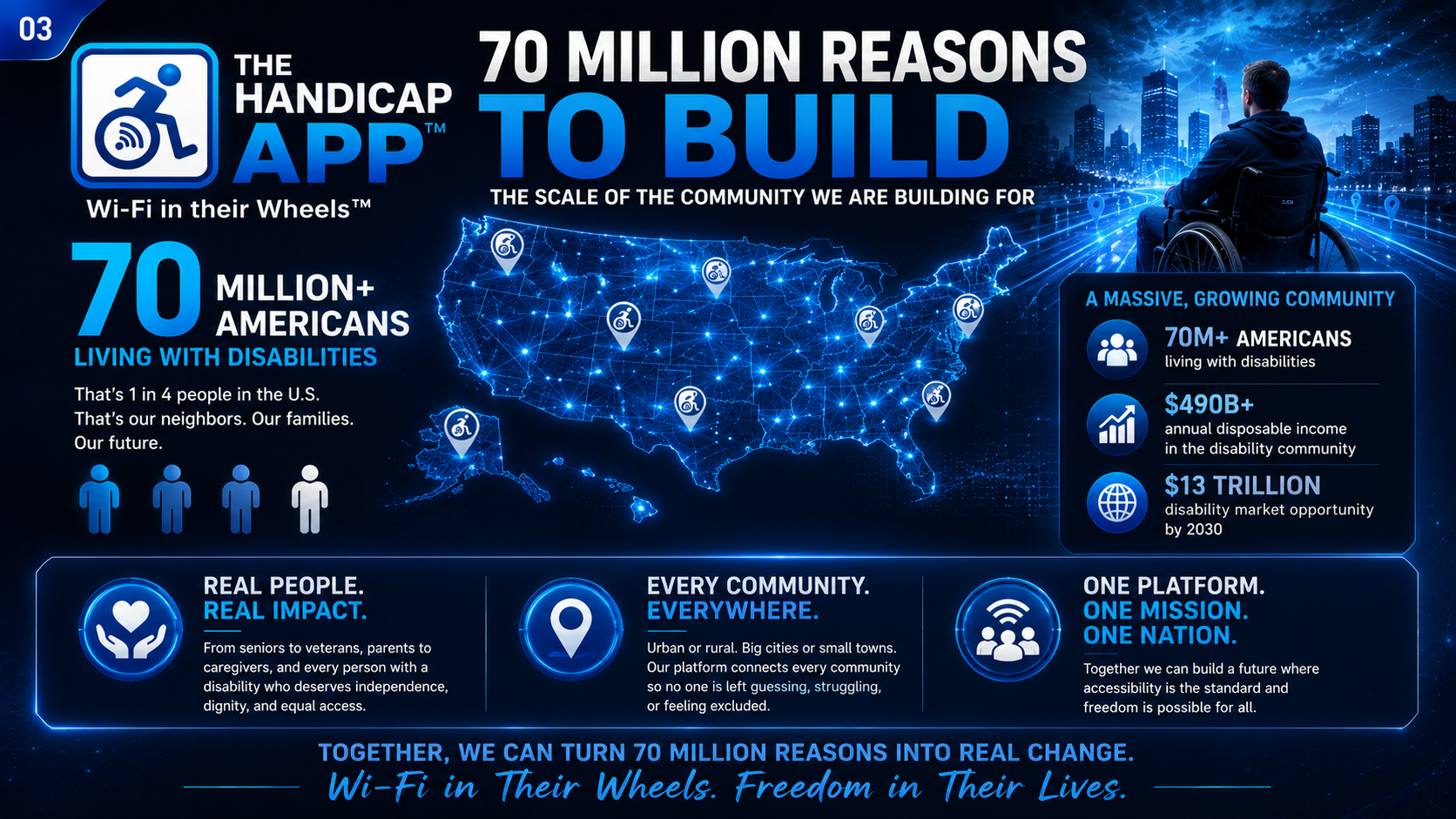
This problem is much larger than one person's experience. More than 70 million American adults live with a disability. Behind that number are millions of individual decisions made every day about where people can go, what they can do, and whether they can participate. We're designing for a massive and historically underserved community. The Handicap App isn't being created because technology needs another application. It's being created because millions of people need better tools to navigate the world around them.”
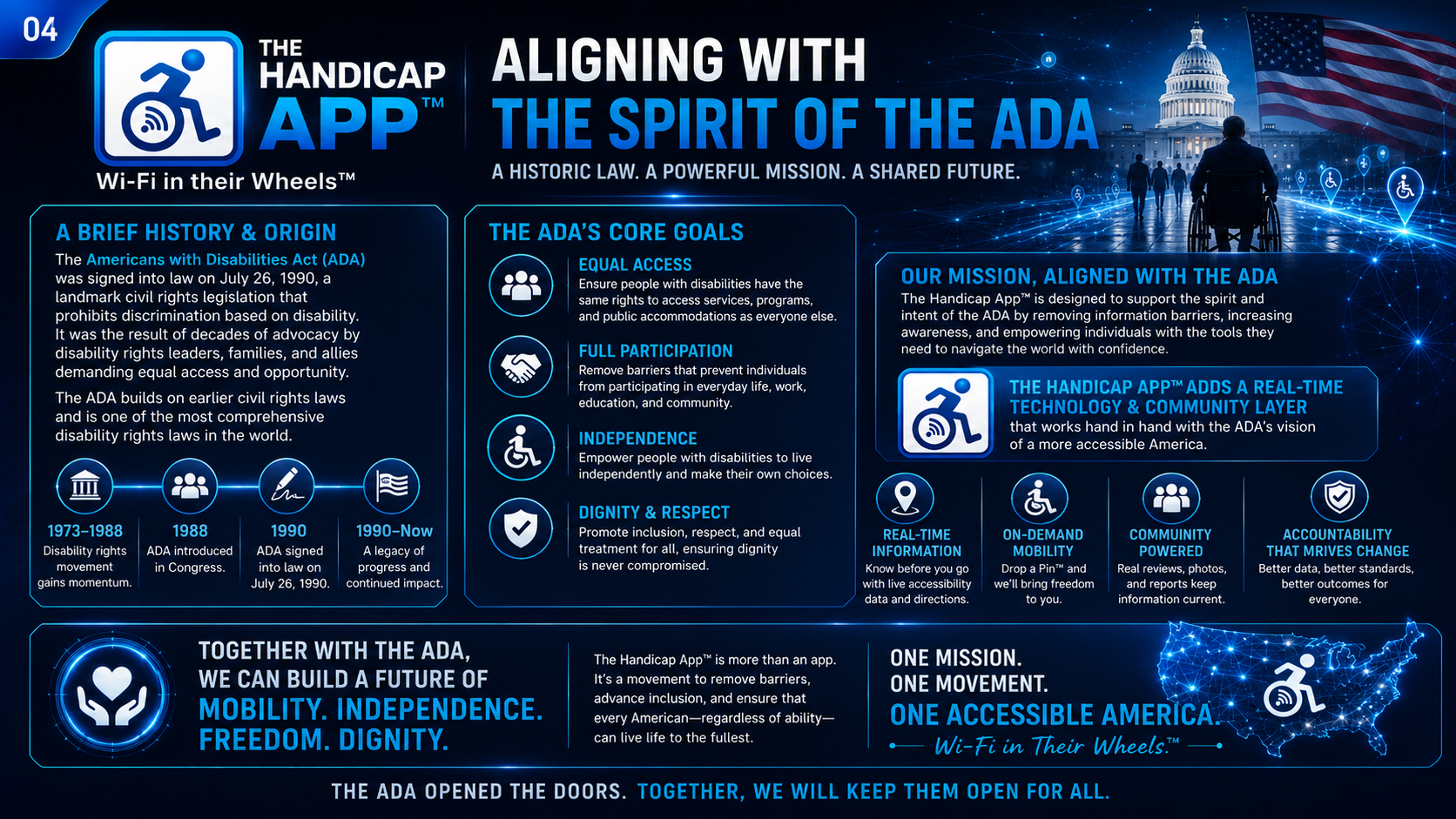
“In 1990, the Americans with Disabilities Act established a landmark national commitment to equal opportunity, access, participation and independence for people with disabilities. More than three decades later, tremendous progress has been made—but real-world accessibility remains inconsistent. The Handicap App is not intended to replace the ADA or determine legal compliance. Our goal is to add something today's world desperately needs: a real-time technology and community layer that helps people understand accessibility as they actually experience it. We want technology to help advance the same larger objective—a more accessible America built around mobility, independence, freedom and dignity.”
.
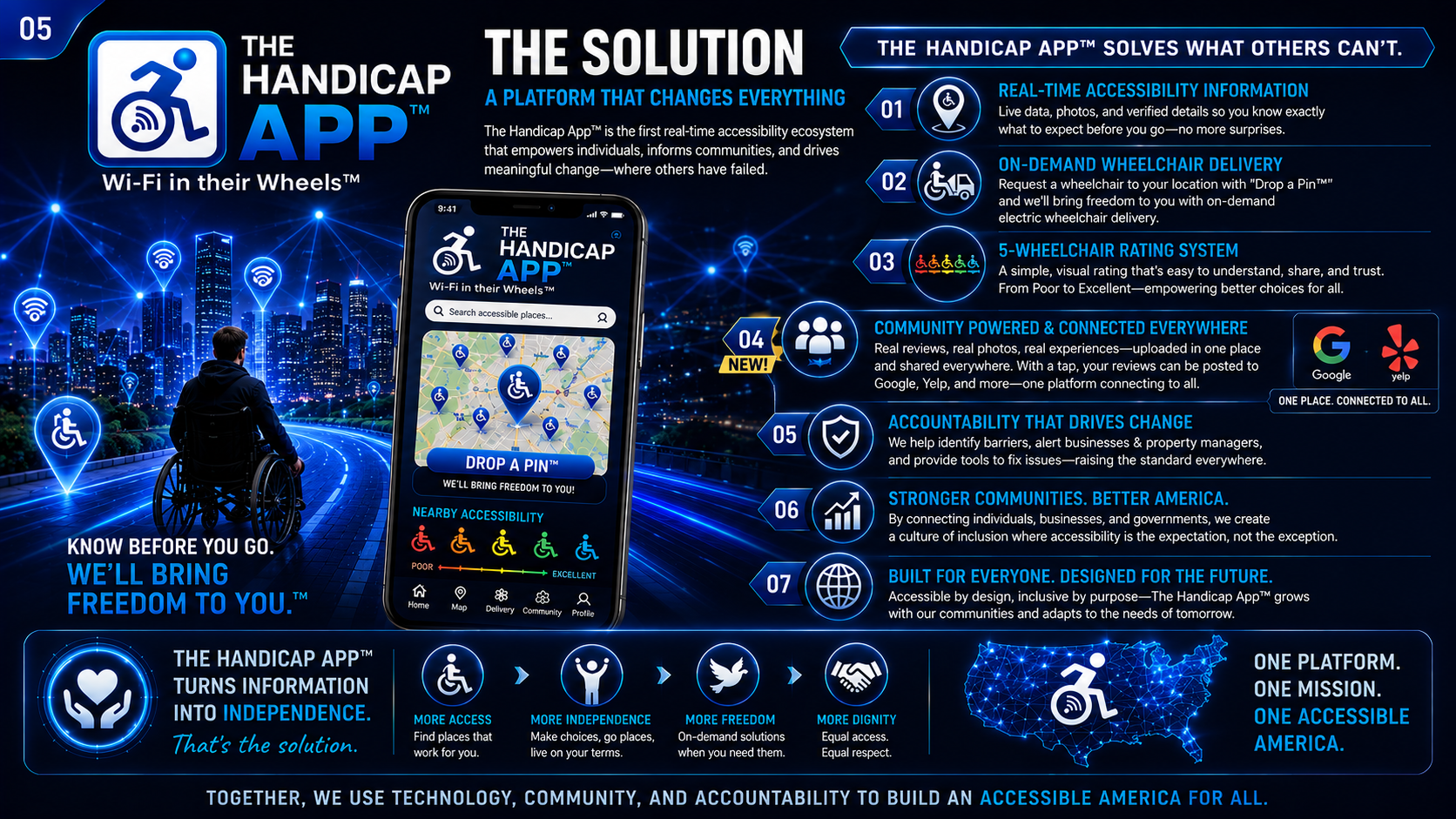
“So how do we begin solving the problem? By bringing essential accessibility tools together into one platform. The Handicap App combines real-time accessibility information, destination profiles, our five-wheelchair rating system, community reviews, mobility assistance through Drop a Pin, and tools that allow businesses to respond to accessibility concerns. A user can contribute an accessibility review inside The Handicap App and, where outside platforms permit it, share that experience into the broader review ecosystem. Instead of accessibility information being fragmented across dozens of places, we envision one accessibility platform connecting the dots.”
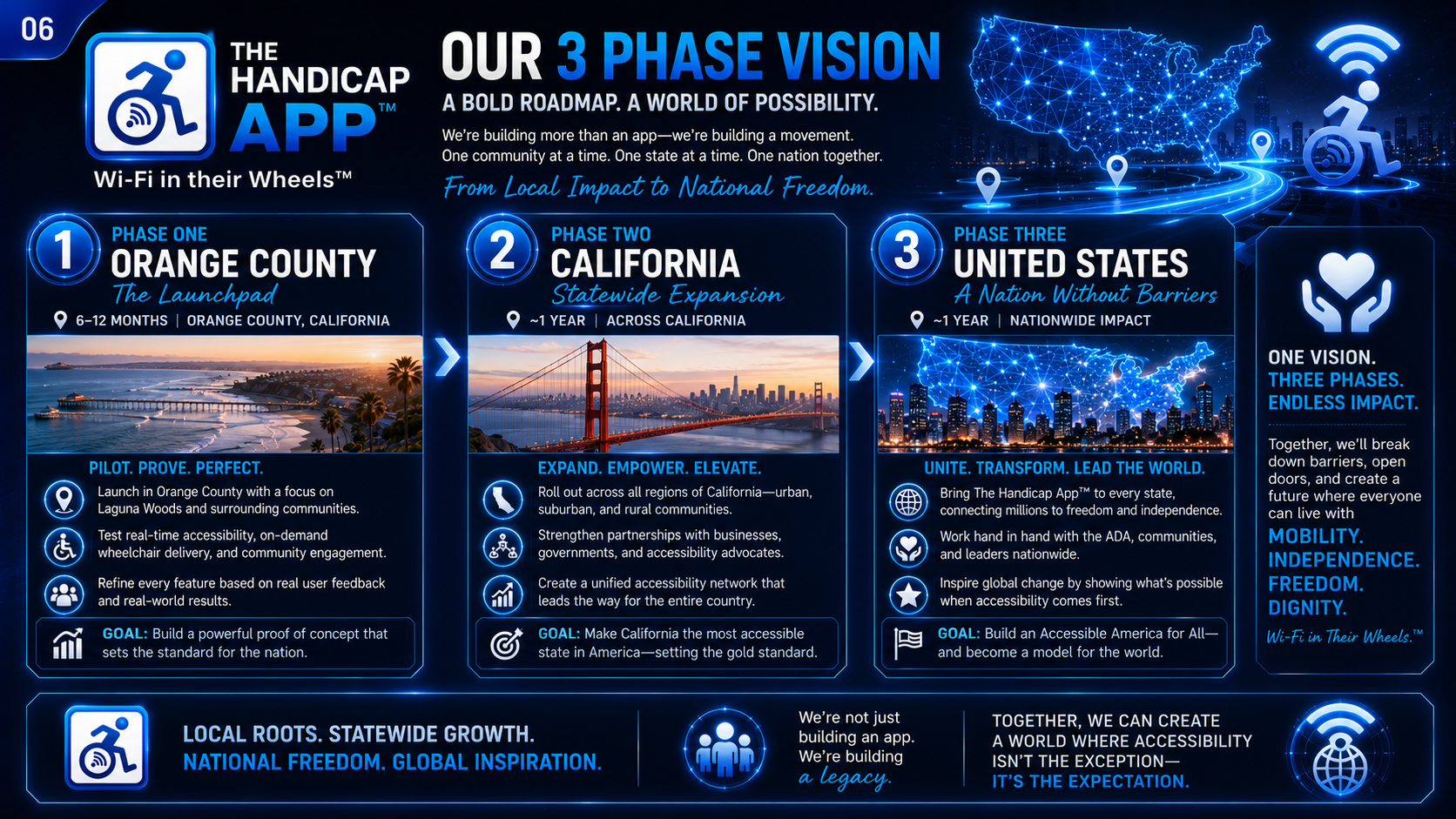
“We have a large vision, but we're approaching it deliberately. Phase One is Orange County. Build it, test it, learn from it and prove the model. Phase Two is California. Expand the platform, data, partnerships and community. Phase Three is America. Take what works and build a national accessibility platform. We don't need to build America on day one. We need to build the foundation correctly on day one so that Orange County can eventually become California—and California can become America.”
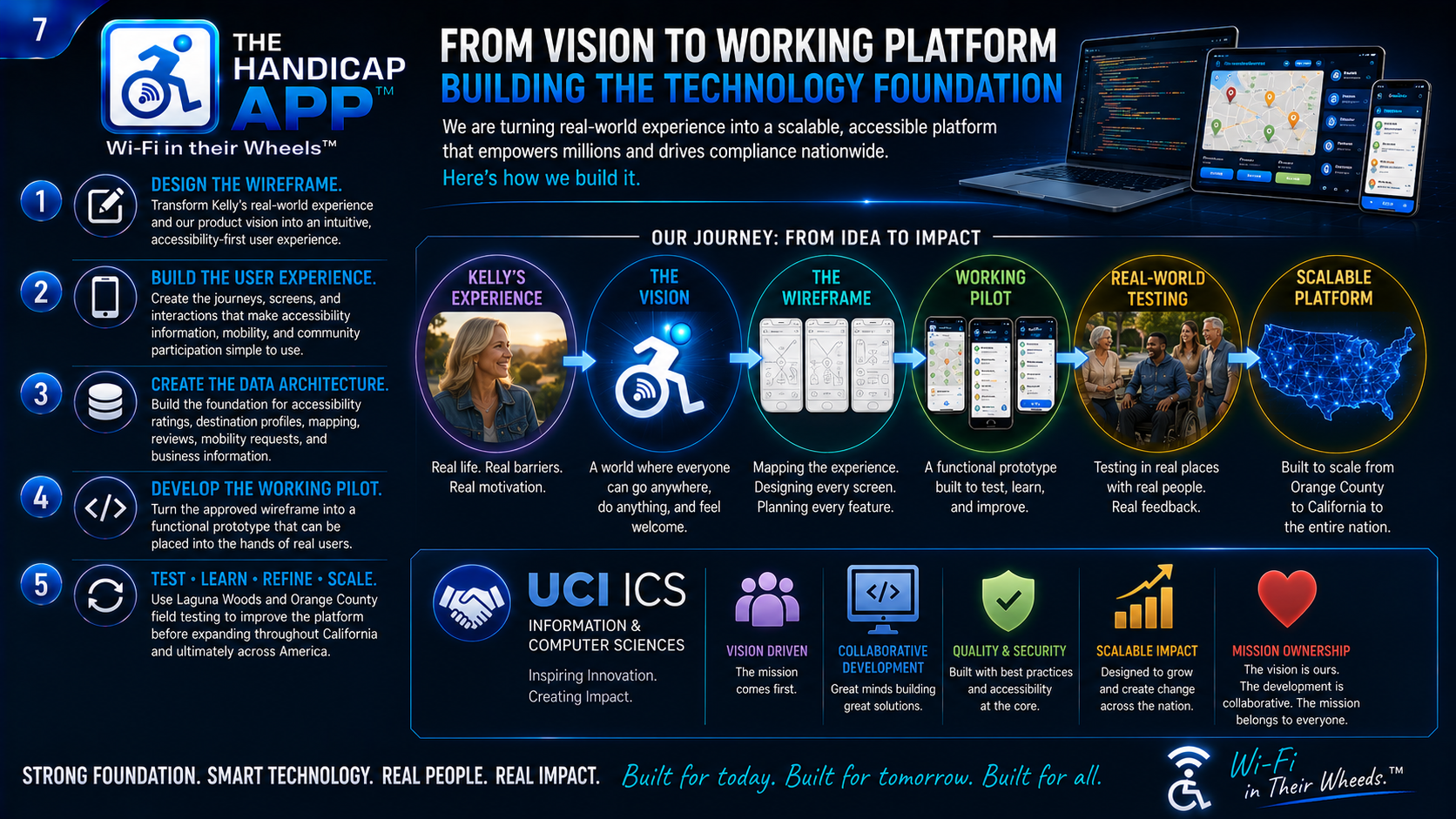
“This is where vision has to become technology. We need to translate lived experience into an intuitive wireframe, build the user experience, establish the data architecture, develop a functional pilot and then put that technology into the hands of real people. The important principle is scalability. We're not interested in building an Orange County application that eventually has to be thrown away and rebuilt. We want Orange County to be the first geographic implementation of an architecture capable of growing much further. Build the foundation. Test it. Learn. Refine. Scale.”
“The user experience should feel remarkably simple. Someone opens The Handicap App because they have a question: Can I successfully navigate where I'm going? They search or use the map, select a destination, see its accessibility information and rating, read experiences from other users, and make an informed decision. If they encounter new information, they contribute it back to the community. The entire user journey is designed around one transformation: uncertainty into confidence.”
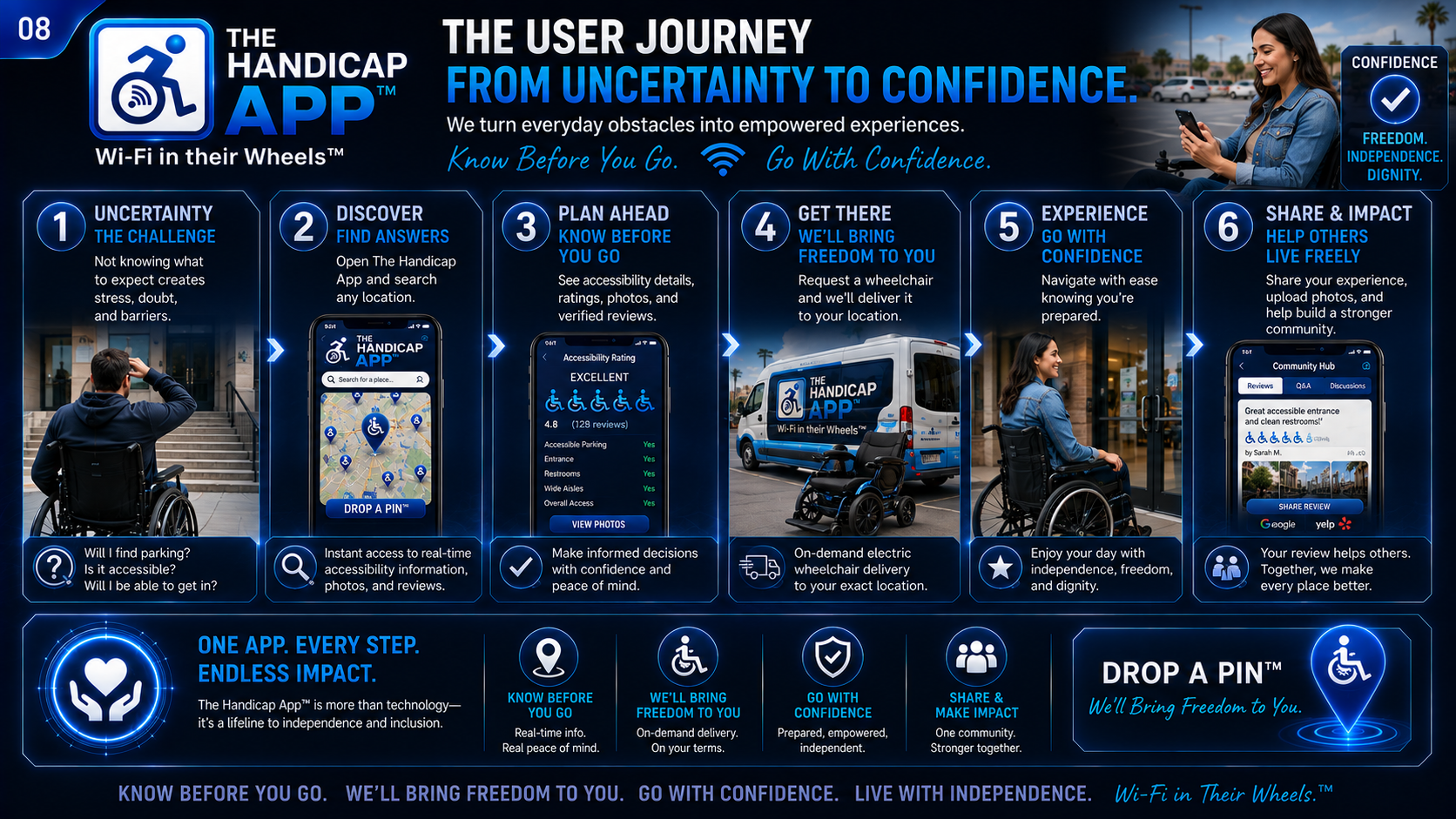
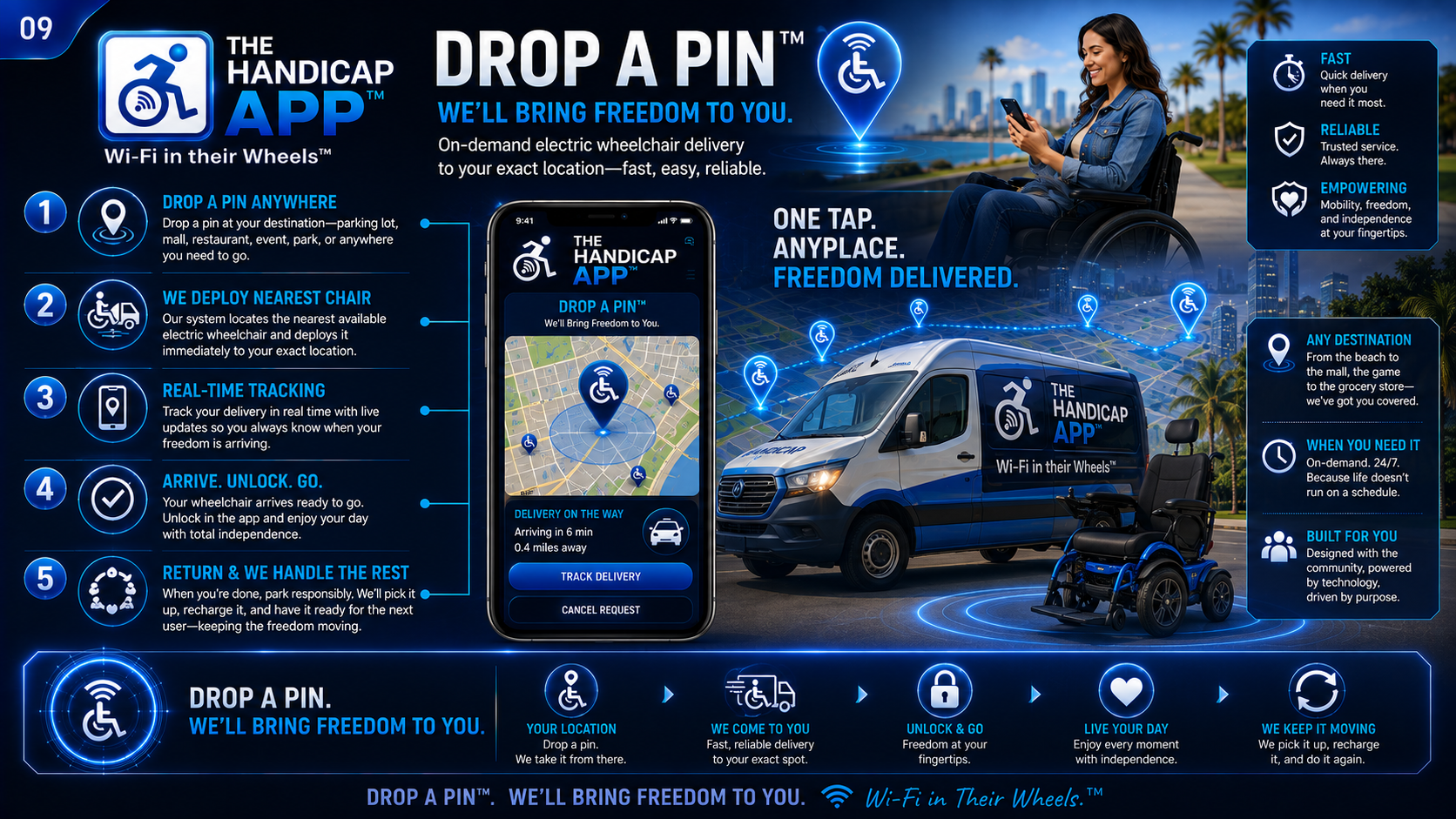
“Drop a Pin is one of our most ambitious mobility concepts. Imagine arriving at a shopping center, medical facility, entertainment venue or other destination and realizing the distance is simply too far to navigate. The user opens The Handicap App, drops a pin at their location, requests available mobility assistance, receives status information, and—within a participating mobility network—has assistance brought to them. The pilot will help us determine the technology, operational relationships and logistics required to make this concept work safely and reliably. The idea is simple: Mobility comes to you.”
“The Live Accessibility Map becomes the user's window into the community. Instead of searching the internet and hoping to find accurate information, users see nearby destinations and accessibility information in one place. They can discover accessible locations, understand potential barriers, compare destinations and make better decisions before traveling. And because accessibility changes, the information shouldn't remain static. Community participation helps make the map increasingly useful over time. Know what's there before you get there.”
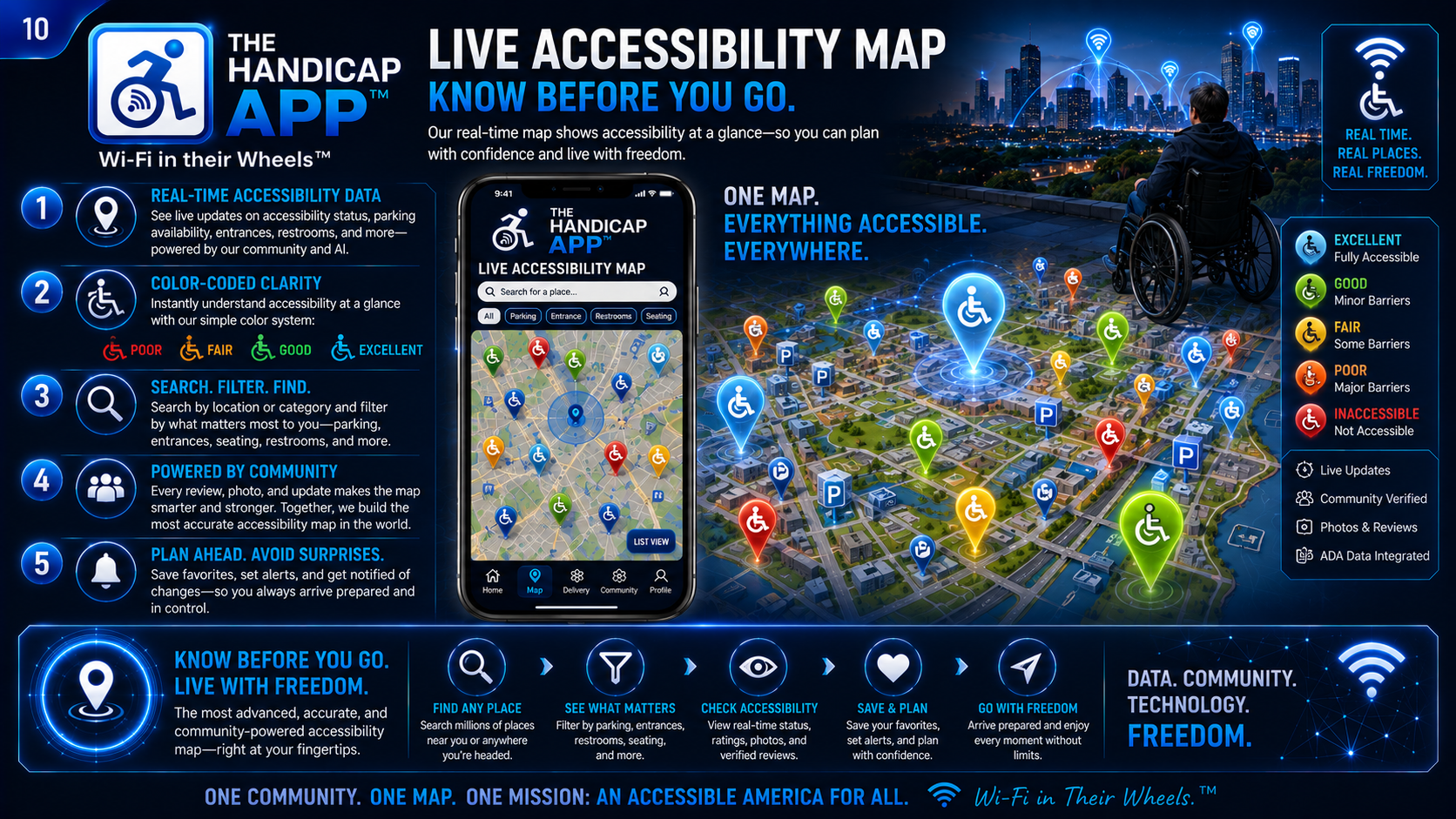
“We also want to create an instantly recognizable language for accessibility. Instead of stars, The Handicap App uses a five-wheelchair accessibility rating system based upon our forward-moving Wi-Fi wheelchair symbol. One through five represents Poor, Fair, Good, Very Good and Excellent accessibility. But the score isn't just decoration. Behind it should be structured information explaining why a destination received that rating. Our long-term vision is for the five-wheelchair system to become a recognizable accessibility standard that people immediately understand wherever they encounter it.”

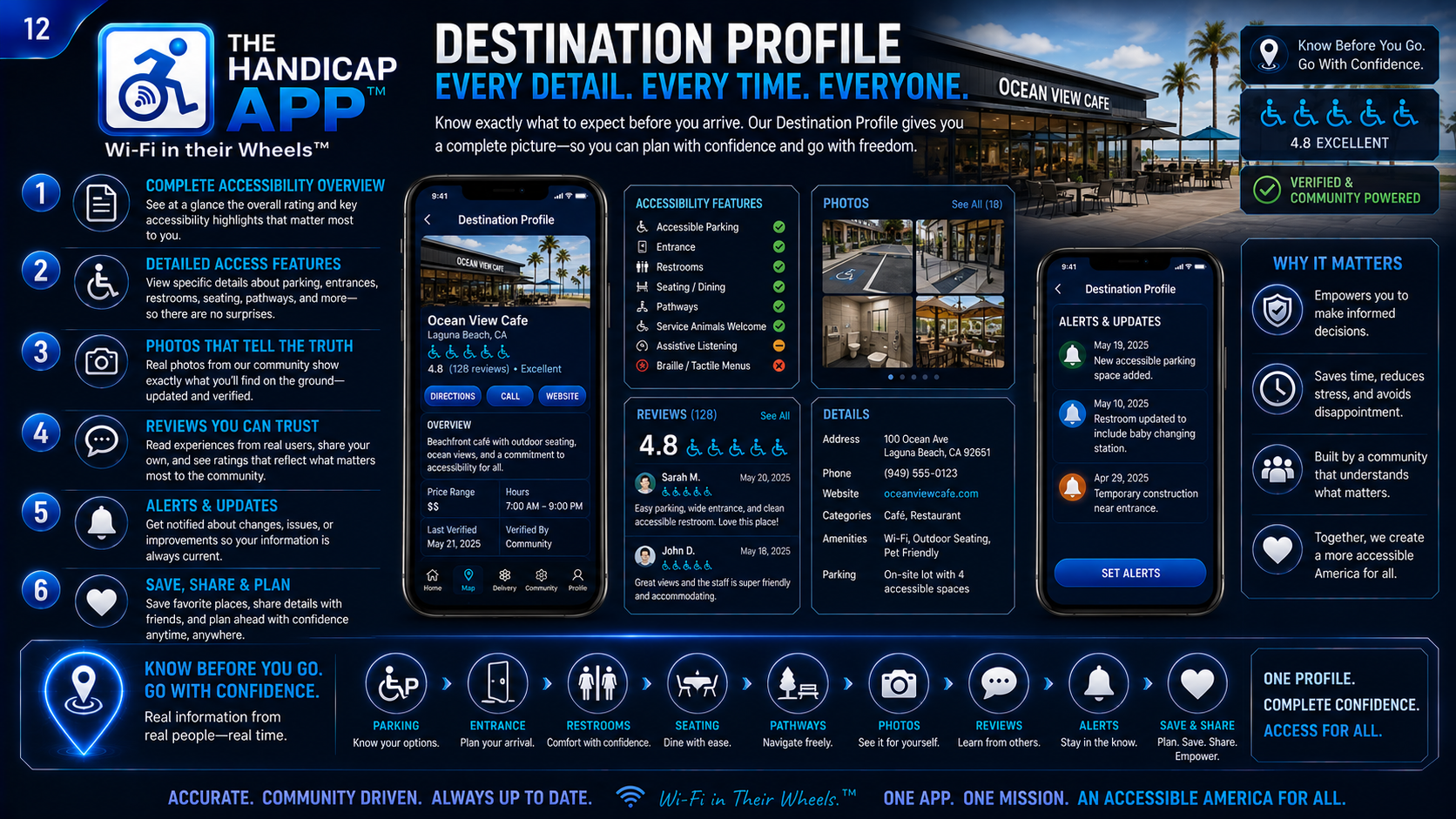
“A single accessibility score can never tell the entire story. That's why every destination needs a detailed accessibility profile. Accessible parking. Entrance conditions. Steps. Doorways. Interior navigation. Restrooms. Mobility assistance. Photos. Reviews. Reported barriers. Different disabilities create different needs. The destination profile allows someone to go beyond a number and understand what they are actually going to encounter. Because sometimes one small detail determines whether someone can participate—or has to turn around and go home.”
“No database can understand accessibility as well as the people navigating these environments every day. That's why community is fundamental to this platform. Users can share experiences, ask questions, upload photos, report barriers and help verify information. One person's experience can become another person's warning—or another person's confidence. The community isn't simply consuming accessibility information. The community helps build it.”
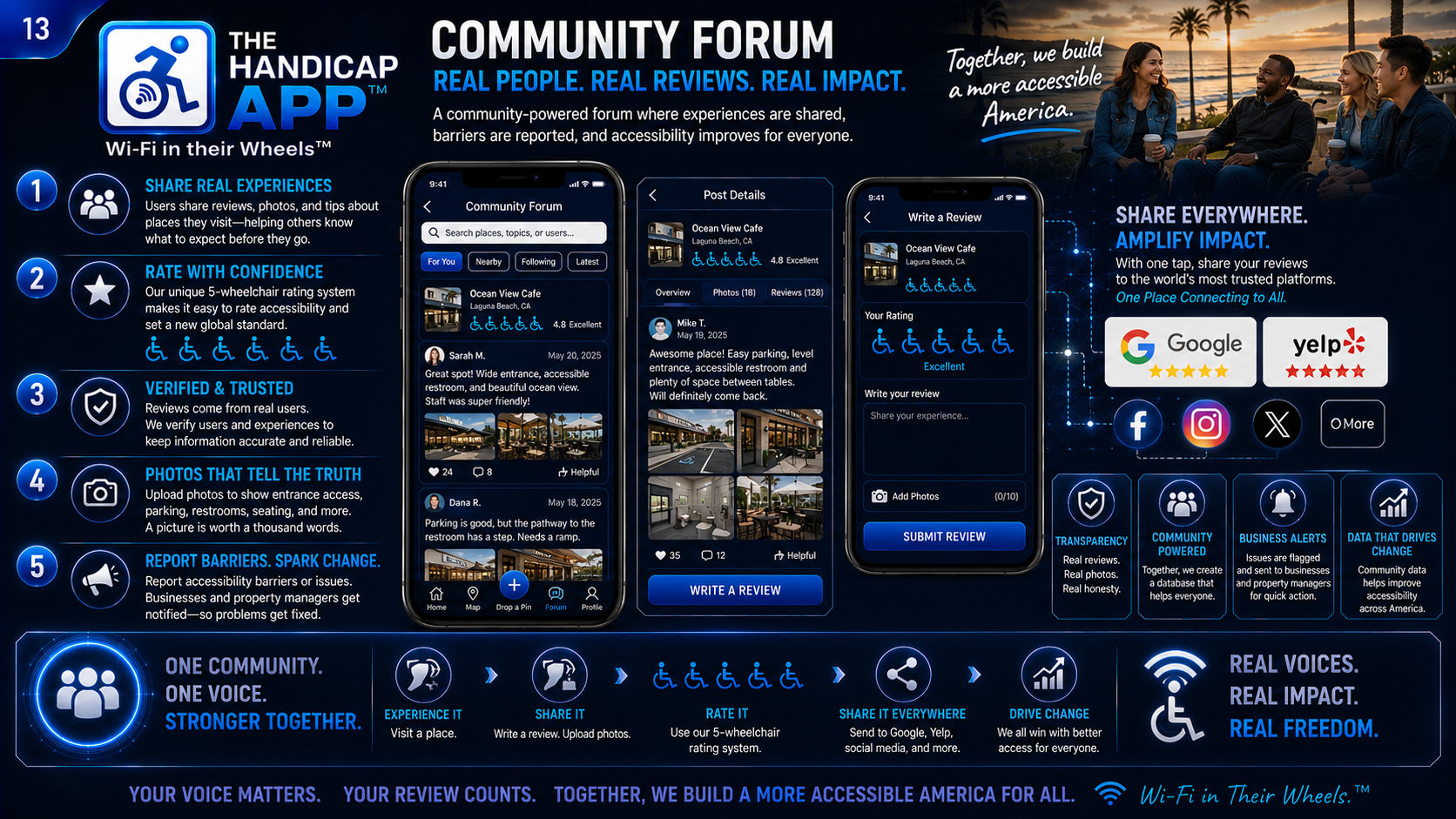
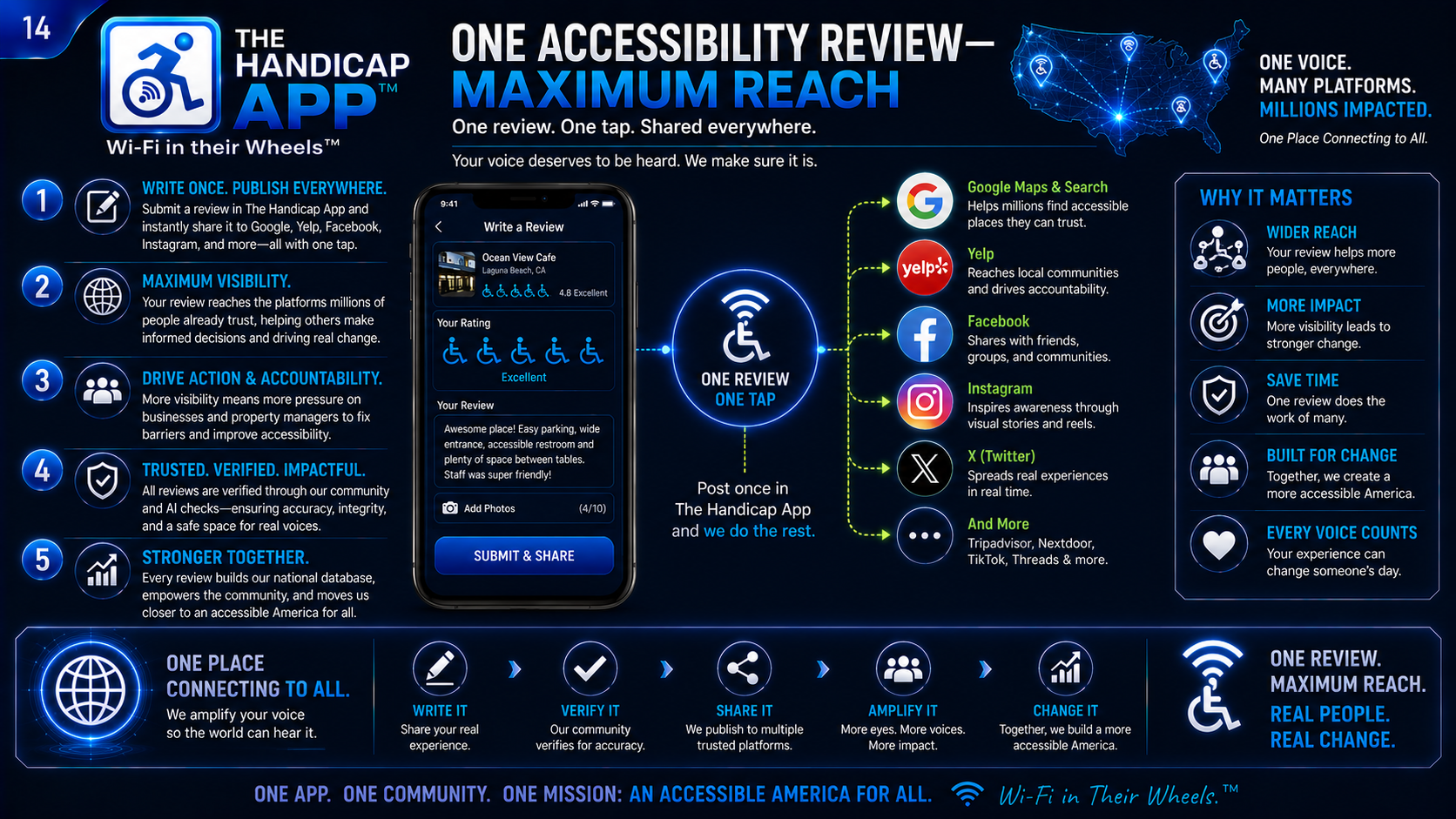
“We don't want valuable accessibility experiences trapped inside one application. A user should be able to create a meaningful accessibility review in The Handicap App and, where external platforms permit it, share that experience into the broader digital review ecosystem. Our goal is to make accessibility feedback more visible to businesses and the general public. Long term, we envision The Handicap App becoming a central accessibility voice that connects with the platforms people already use. One experience. One accessibility voice. Maximum reach.”
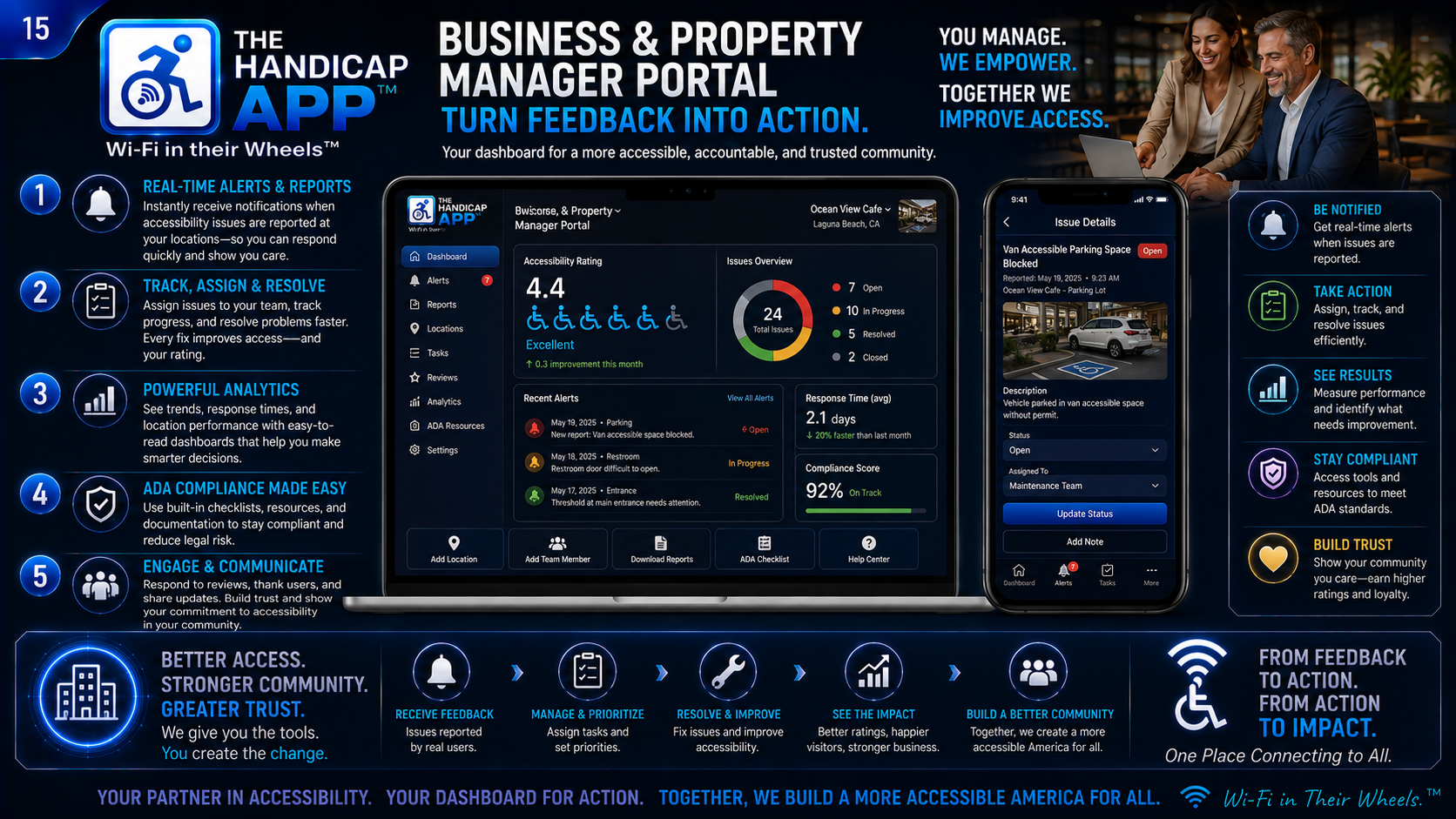
“Reporting a problem is only half of the solution. The other half is giving businesses and property managers the tools to do something about it. Through the Business and Property Manager Portal, organizations can receive accessibility feedback, understand reported barriers, update information, respond to users and document improvements. This changes the relationship from accusation to collaboration. The objective isn't simply to identify what's wrong. It's to create a technology-driven pathway for businesses to understand barriers and make things better. Feedback becomes action.”
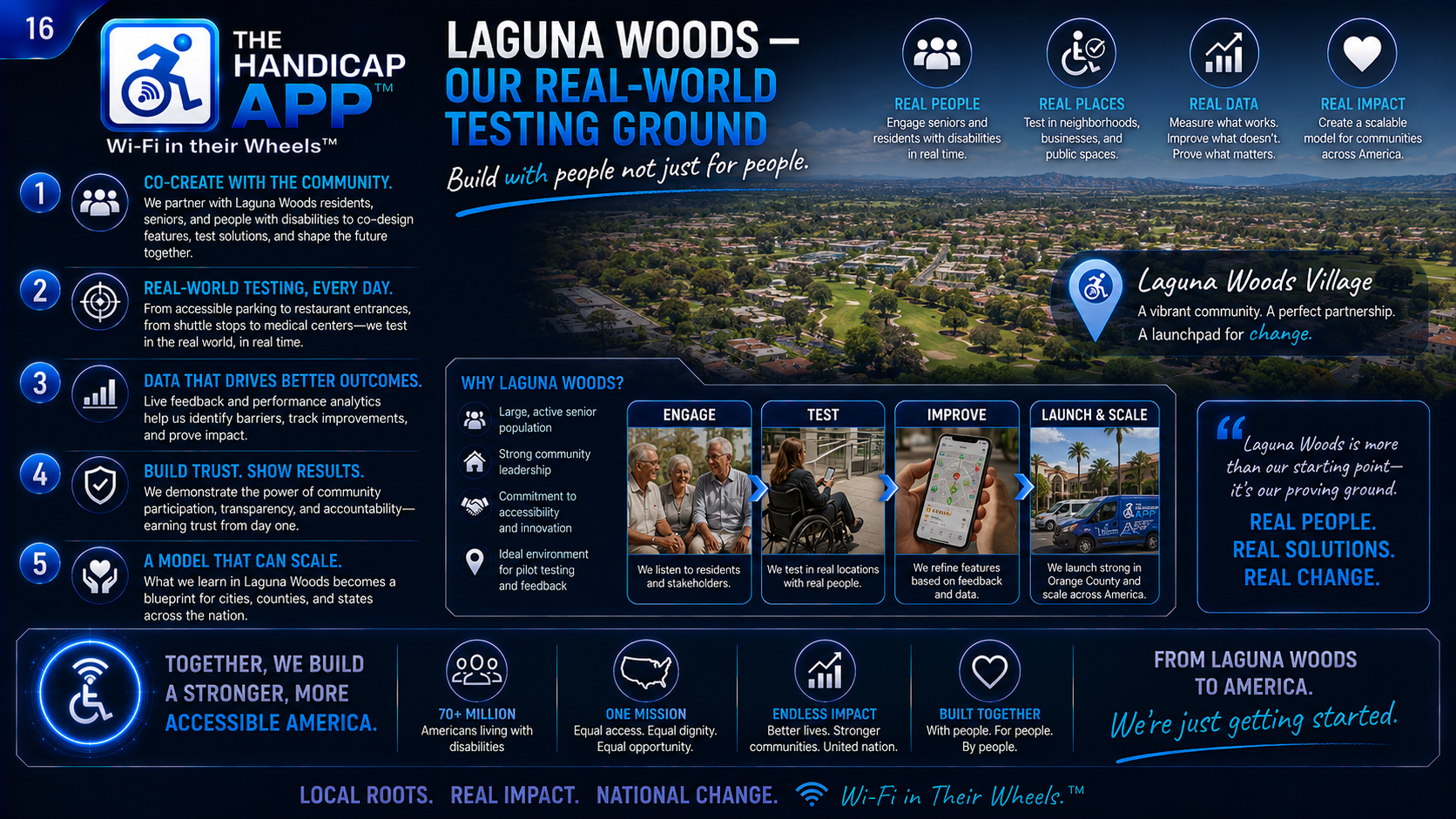
“Technology like this cannot be designed entirely from behind a desk. That's why Laguna Woods and the surrounding Orange County community are so important to our pilot. We want real users navigating real destinations and giving us real feedback. What worked? What didn't? What was confusing? What information was missing? What would have changed their experience? We're not trying to build something for people and then tell them what they need. We want to build it with them.”
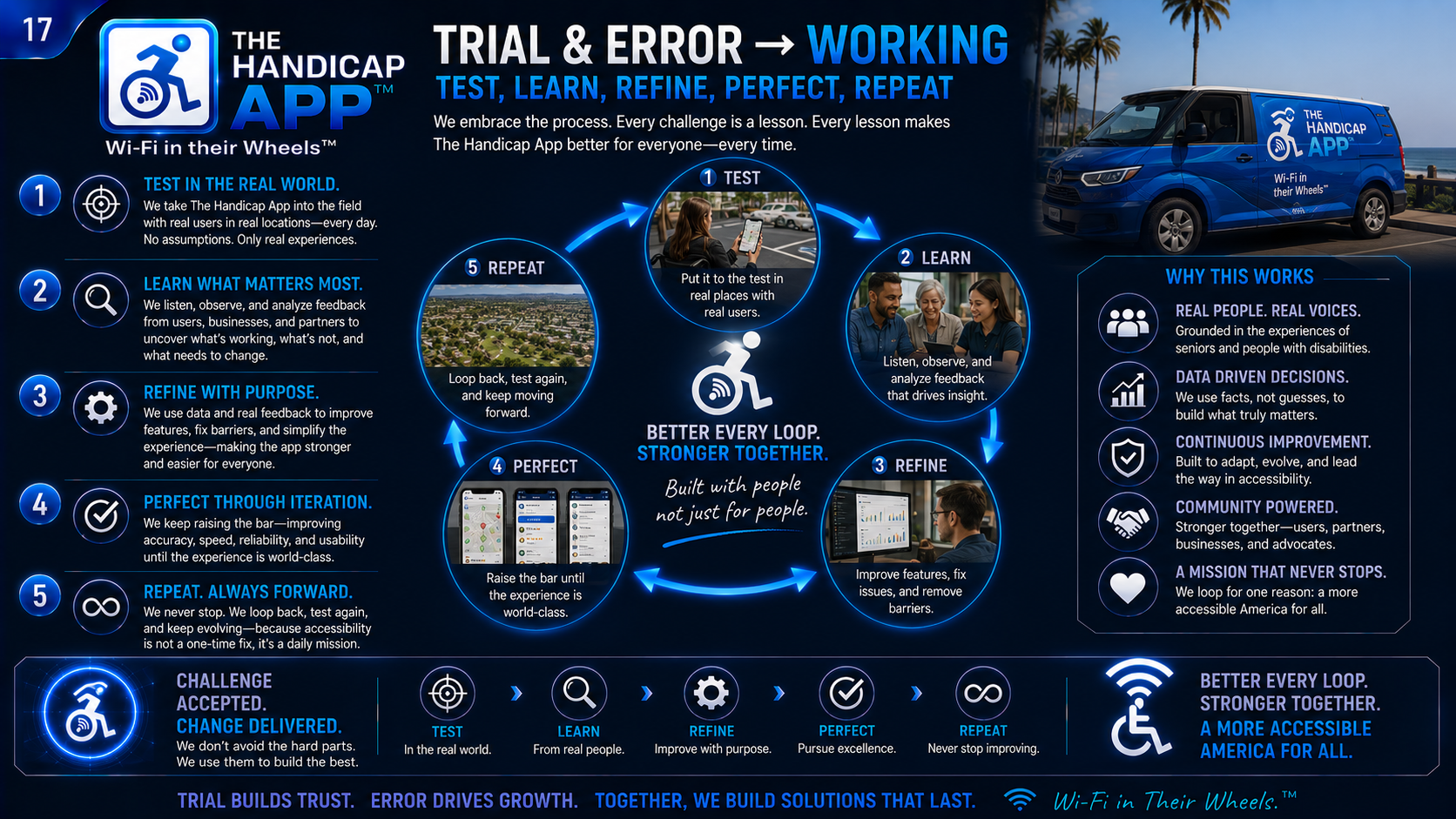
“The first version won't be perfect—and that's exactly why we test. Build. Test. Gather feedback. Analyze. Improve. Then do it again. Every unsuccessful interaction teaches us something. Every confusing screen identifies an opportunity. Every missing accessibility detail improves the data model. The Orange County pilot is our learning laboratory. Test. Learn. Refine. Perfect. Repeat. That's how an idea becomes a dependable working platform.”
“No organization can accomplish this vision alone. The technology connects information, but relationships make the ecosystem work. We need mobility partners, businesses and property owners, healthcare organizations, disability organizations, government agencies, sponsors, funders, community leaders, universities and technology partners. The Handicap App's role is to help connect those pieces around one shared objective: making communities easier to navigate for people with disabilities. The application connects the dots—but people and partnerships bring the system to life.”

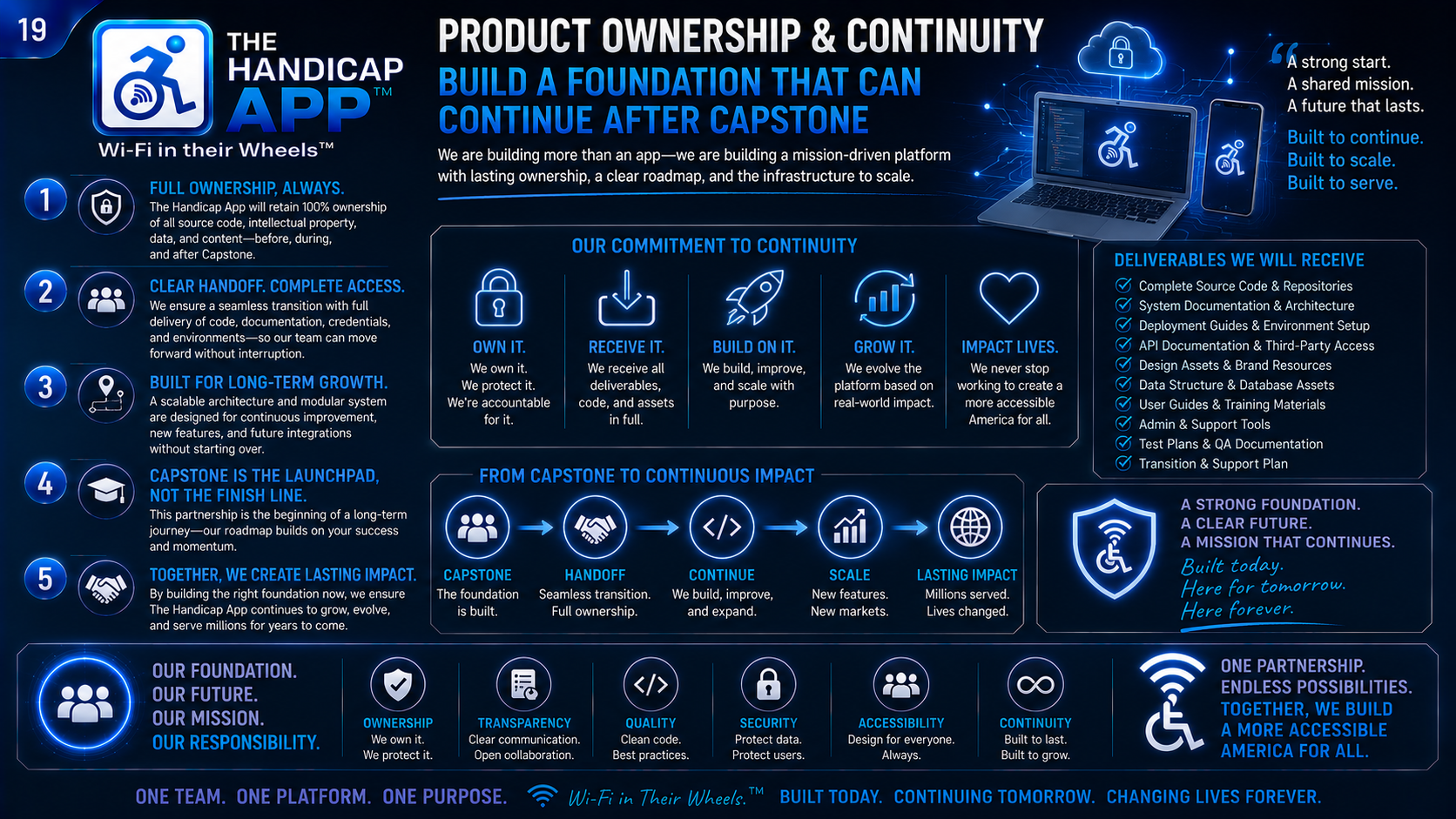
“We also have to think beyond the first development team. The platform must be built so another qualified team can continue the work tomorrow, next year and years from now. That means thoughtful architecture, documented source code, clear data structures, design files, APIs, deployment instructions, testing documentation and a clean development handoff. The Handicap App must maintain the product vision and continuity while talented technology partners help us build it. We're not looking for disposable prototype code. We're trying to establish a foundation that can continue growing.”
“And that brings us to the future. Orange County is where we prove the idea. California is where we demonstrate scale. America is where this can become something much larger. Eventually, the principles, technology and accessibility language we develop could extend even further. But this isn't ultimately about maps, ratings, databases or software. It's about whether a person can participate in everyday life with greater confidence. The future we're working toward is accessible.”
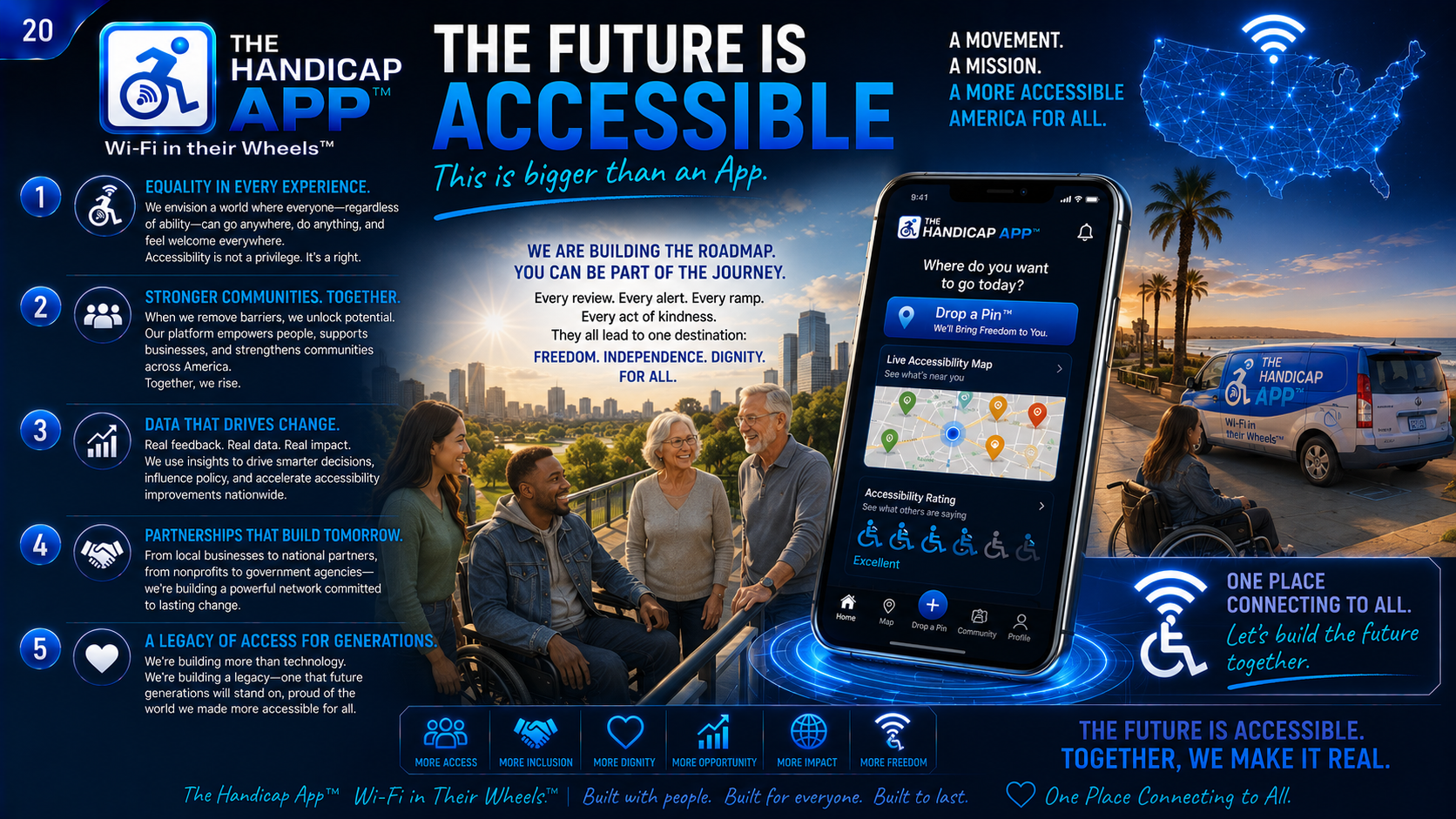
“We want to leave you with one thought. We're not simply asking people to help us build another application. We're inviting people to help build a movement. A movement for mobility. For independence. For freedom. For dignity. A movement that begins with one person's experience, grows through an Orange County community, expands throughout California, and ultimately has the potential to help millions of Americans. Technology gives us tools. Community gives us knowledge. Partnership gives us reach. But people willing to contribute their time, talent and treasure are what will turn this vision into reality. The code we build today could help someone get through the door tomorrow. Seventy-plus million Americans. One shared mission. A more accessible America. This is The Handicap App. Wi-Fi in Their Wheels™. Help us build what comes next.”

“We're not asking you simply to help us build another app. We're inviting you to help build the technological foundation of a movement. A movement that begins in Orange County, expands throughout California, and ultimately has the potential to serve communities across America. Your time. Your talent. Your technology. Our shared mission: a more accessible America. The Handicap App—Wi-Fi in Their Wheels.”